I flew cross-country to surprise my daughter at her mansion… and found her scrubbing floors on her hands and knees while her mother-in-law watched. I didn’t yell. I made one phone call that destroyed their empire.
I’m Elena Vance. Twenty years running a commercial cleaning business in Chicago left me with arthritis, a bad back, and an empty bank account after paying for Sophie’s wedding to the Caldwells—old money, Rhode Island estates, the kind of people who summer as a verb.
Our calls got shorter after she moved East. She always sounded breathless. “Mom, don’t worry. Victoria treats me like her own daughter. I have staff. I have everything we dreamed of.”
I wanted to believe her. So for her second anniversary, I didn’t call ahead. I bought a plane ticket and rented a car. I wanted to see her face light up.
The Caldwell estate took my breath away. Massive iron gates. Manicured hedges. A silence so heavy it felt expensive. The front door was unlocked. I pushed it open, ready to yell “Surprise!”
Then I heard it. The wet swish-swish of a rag against wood.
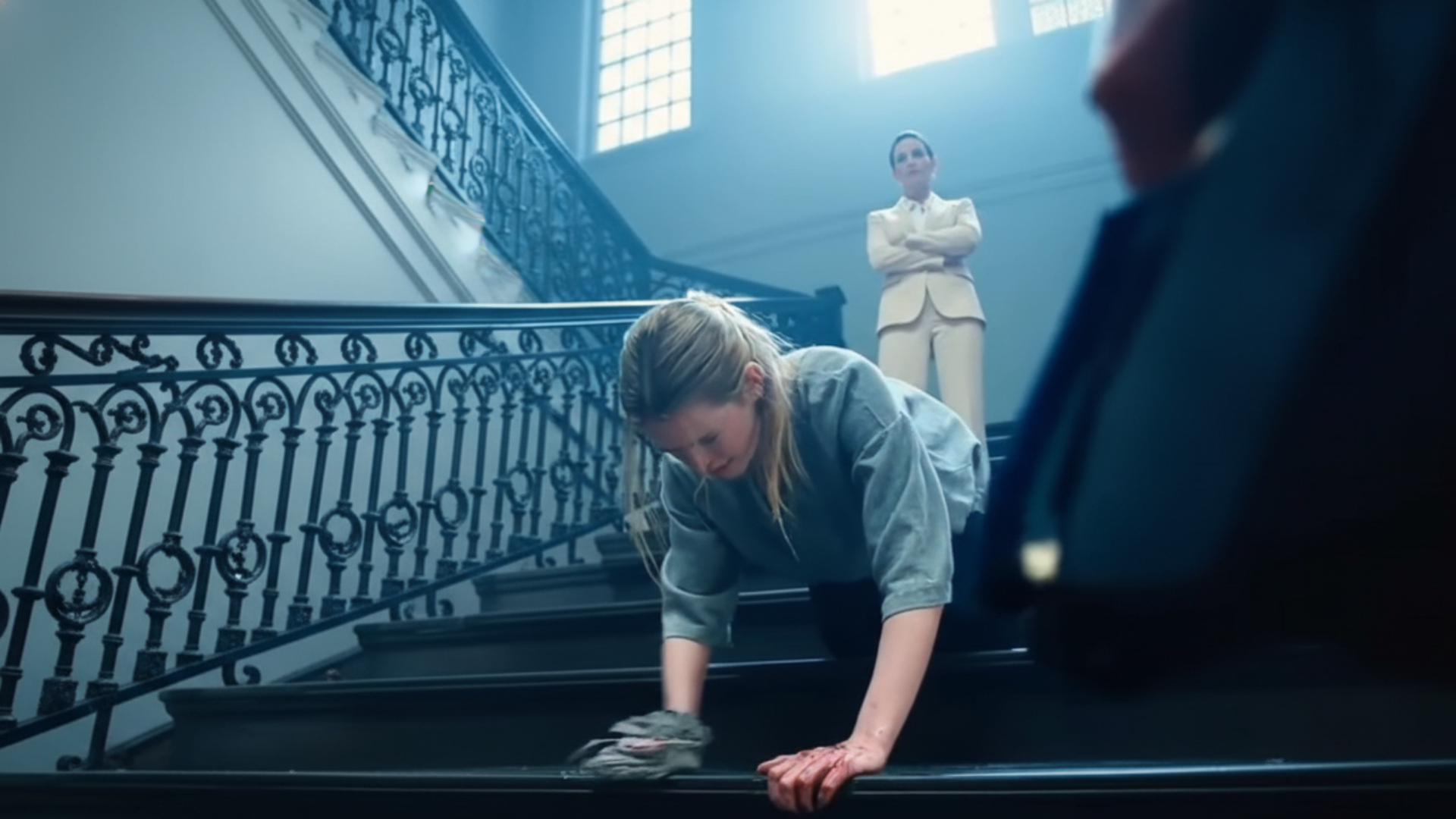
Sophie was on her hands and knees in the marble foyer. No silk dress like her Instagram posts. A grey, shapeless tunic. Messy hair. Scrubbing the bottom step of the grand staircase with grey water.
Victoria Caldwell stood at the top of the stairs like a gargoyle. Arms crossed. Beige silk suit that cost more than my car.
“You missed a spot on the riser, Sophie,” Victoria said, voice cold and bored. “Do it again. Stop crying, it’s unbecoming. The maid is off today, and someone has to make this presentable for the gala.”
My brilliant, college-educated daughter dipped the rag again. Her shoulders shook. “Yes, Victoria. I’m sorry.”
The rage that hit me wasn’t hot. It was absolute zero. The cold clarity of a woman who knows exactly how to remove a stain and exactly how to dismantle a mess.
My heels clicked loudly on the marble. Sophie’s head snapped up. The color drained from her face.
“Mom?”
Victoria looked down, eyes narrowing in annoyance. “Oh. The help has arrived. I suppose you’re here to show her how to do it properly?”
I dropped my bag. It hit the floor with a heavy thud.
“Get up, Sophie.”
“Mom, please,” Sophie scrambled up, wiping her hands on her tunic, looking terrified. “It’s not what it looks like. I was just helping…”
“She is learning humility,” Victoria interrupted, descending one step. “Something you clearly failed to teach her.”
I looked at my daughter. Really looked. The weight loss I hadn’t noticed on FaceTime. The red, chapped hands. The terror in her eyes.
This wasn’t a one-time punishment. This was her life. They’d turned my daughter into staff because they believed that was all she was good for.
I didn’t yell. I smiled. The same smile I used when a client tried to stiff me on a bill.
“Humility. That’s an interesting word, Victoria.”
I walked over to Sophie, took the wet rag from her hand, and dropped it into the bucket. Splash.
“Pack your bag, Sophie. The small one. We’re leaving.”
“She isn’t going anywhere,” Victoria scoffed. “Her husband—”
“Her husband,” I cut in, looking up at the woman on the stairs, “is about to have a very bad day. You see, Victoria, you think I’m just a cleaner. But cleaners see everything. We find the papers left on desks. We empty the shredders. And my company holds the contract for the investment firm your husband uses to hide his assets from the IRS.”
Victoria’s arrogance faltered. “Excuse me?”
“I’ve been cleaning the offices of Caldwell & Associates for five years,” I lied smoothly. I hadn’t, but I knew the industry. I knew people like her always had secrets. “I know about the Cayman accounts. I know about the ‘consulting fees’ that never get reported. And I know that if my daughter isn’t in my rental car in five minutes, I’m making a call to an old friend at the Department of Justice.”
It was a massive, terrifying gamble.
Victoria stood frozen on the stairs. The silence returned, but this time it wasn’t expensive. It was heavy with fear.
“Sophie,” I said, not looking away from the older woman. “Go.”
Sophie ran.
As we drove away, Sophie sobbing in the passenger seat, she told me everything. The emotional abuse. The forced labor “to earn her keep.” The isolation from friends. The constant reminders that she was “lucky” to be there.
“He watched, Mom,” she whispered. “My husband watched and said nothing. He told me it would be good for me. That I needed to respect his mother’s traditions.”
We didn’t go back to Chicago immediately. We went to a lawyer in Providence. A woman lawyer who’d grown up working-class and hated entitled rich people.
“Do you have any proof of financial crimes?” she asked.
Sophie nodded, hands shaking. “I saw papers. In the study. While I was cleaning. I… I took pictures. I thought maybe I was going crazy, that I was seeing things wrong, but the numbers didn’t make sense.”
She pulled out her phone. The lawyer’s eyes went wide.
“This is a federal case,” she said quietly. “This is wire fraud. Tax evasion. We’re talking years in prison.”
Turns out, I didn’t need to lie about the fraud at all. Sophie had documented everything while they forced her to dust their crimes.
We filed for divorce. We filed a report with the IRS. We filed another with the FBI.
The Caldwells fought back at first. Their lawyer sent threatening letters about “defamation” and “family reputation.” Victoria called Sophie’s phone thirty times in one day, screaming about betrayal and ingratitude.
Then the federal agents showed up at the estate.
The investigation took four months. They found offshore accounts in three countries. Shell corporations. Fraudulent deductions going back fifteen years. The firm’s other partners flipped immediately, desperate to save themselves.
Sophie’s husband tried to reconcile. Showed up at my house in Chicago with flowers and tears.
“I didn’t know it was that bad,” he said. “My mother can be… traditional. I thought Sophie was adjusting.”
“You watched your wife scrub floors,” I said from the doorway. “You didn’t think that was bad?”
He had no answer.
The divorce was finalized three weeks before his father’s trial. Sophie got nothing from the marriage—the prenup Victoria had insisted on made sure of that. But she didn’t want anything from them anyway.
The trial was brutal and public. The press loved it. “Old Money Family’s Dirty Secrets.” “Socialite’s Daughter-in-Law Exposes Fraud.” “From Mansion to Courtroom: The Caldwell Collapse.”
Sophie testified. She was calm, clear, devastating. She showed the photos. She described the emotional abuse. She explained how being forced to clean every room in the house had given her access to every document they’d tried to hide.
Victoria sat in the gallery in her beige silk suit, face frozen in fury.
The father got eight years in federal prison. The son got three years probation and a lifetime ban from financial services. The firm was dissolved. Assets seized.
The estate—the one with the marble foyer and grand staircase—was auctioned off to pay restitution and back taxes.
Six months after the sentencing, I heard through a friend that Victoria was living in a small two-bedroom apartment downtown. The kind with thin walls and a coin laundry in the basement.
I hope she keeps it clean.
Sophie lives with me now in Chicago. She’s back in school, getting her MBA. Some nights she still wakes up anxious, thinking she forgot to dust something or polish something.
But mostly, she’s healing. She’s laughing again. She’s remembering who she was before they tried to break her.
Last week, she asked if she could take over some accounts for my cleaning business. “I want to help, Mom. The right way this time. As your daughter. Not as anyone’s servant.”
We’re building something new together. Something clean.
Leave a Reply